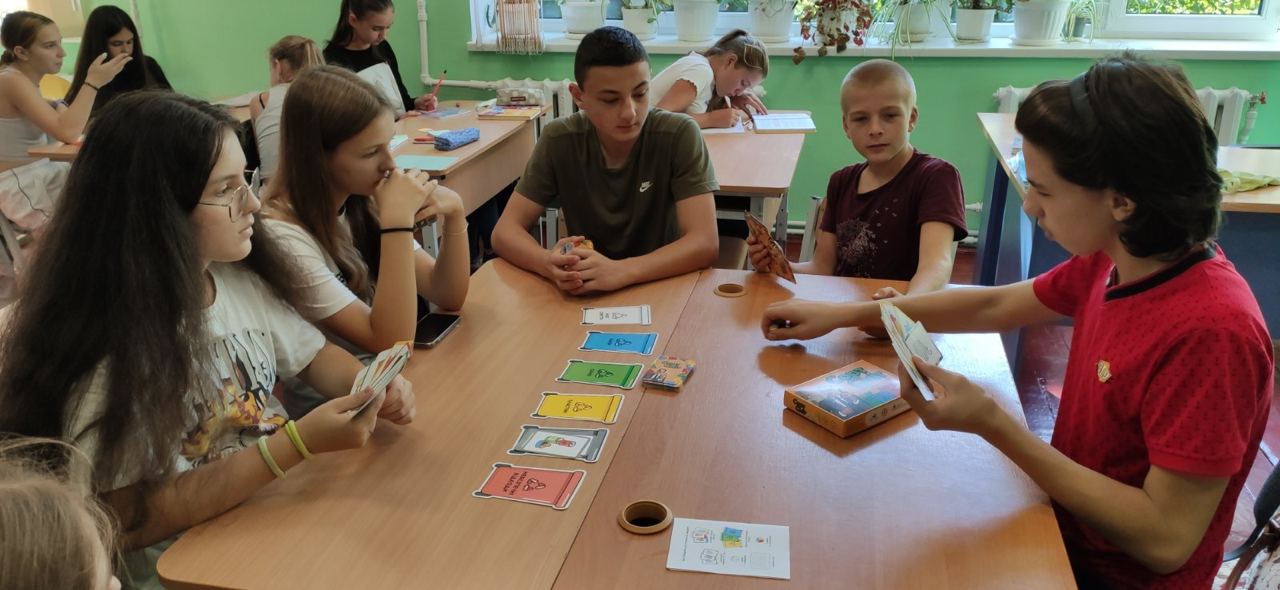
Orysia Krechko, a biology and ecology teacher at Turi Remety Secondary School, is on a mission to explain the global Sustainable Development Goals (SDGs) to her students through an engaging environmental board game called “Smith’s Sort.” In the biology and ecology curriculum, there exists a challenging yet critically important topic: “Strategy for Sustainable Development of Nature and Society.” This subject delves into the exploration and comprehension of the SDGs, which were collectively agreed upon by 193 countries between 2015 and 2030. These goals aim to address pressing global issues, including poverty, hunger, inequality, subpar living conditions, environmental degradation, and more.
What sets these goals apart is their call to action, not only for wealthy nations but also for poor and middle-income countries, all with the common purpose of advancing prosperity, safeguarding our planet and enhancing the quality of life for generations to come. In total, there are 17 global goals, and each nation tailors its approach to prioritize and achieve them according to its unique capabilities and available resources. Ukraine has joined this worldwide effort by adopting the Sustainable Development Strategy of Ukraine, spanning until 2030.
To make the content of these global goals related to nature conservation accessible to 10th-grade students and to provide real-world examples of their achievement, Orysia Krechko employed the eco-game “Sort Smith”. She conducted a workshop on waste sorting, illustrating which sustainable development goals could be realized through these straightforward yet incredibly significant skills.
One notable feature of the “Sort Smith” board game is that it not only encourages students to collaborate actively as a team while tackling environmental issues but also helps them easily remember the categories to which different types of recyclables belong. This is why the teacher decided to introduce the game to 9th-grade students, especially in honor of the approaching World Cleanup Day, celebrated on the third Saturday of September. The students were so enamored with the game that they continued to use it during their leisure breaks, making it an enjoyable and educational addition to their daily routine.


The event was organized by the Interreligious Civil Environmental Forum of Eastern Europe (IRCEF) (headed by Olexander Bokotey) and the German Nature Conservation Union (NABU Bundesverband, NABU International), project coordinators Ivan Tymofeiev (NABU), Nataliya Kulya (IRCEF).
Informational service of IRCEF