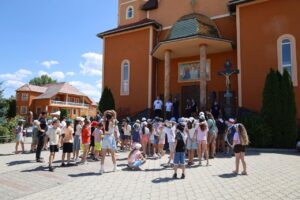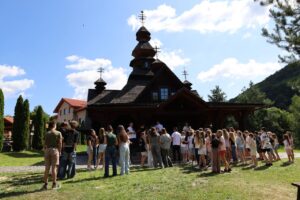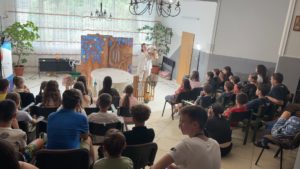

Schoolchildren from Berehove actively participated in a birdwatching event led by volunteers from the “Everyone Can Help” public center. The focus of this educational initiative was to teach children how to monitor the wintering grounds of long-eared owls. Long-eared owls, being a partially resident species, embark on seasonal migrations, heading south in the autumn and returning to their native land with the onset of spring. These migrations can vary in distance, with some covering short spans of 50-100 km, while others involve extensive journeys, spanning over 2000 km from Eastern Europe to Portugal.
This year, a small group of long-eared owls chose to settle near a church in Berehove. Leonid Pokrytyuk, a local ornithologist and expert from the Interreligious and Civil Environmental Forum of Eastern Europe, has taken on the responsibility of regularly visiting and monitoring the birds’ wintering conditions. Furthermore, he dedicates time to imparting knowledge about the rules and significance of observing long-eared owls to the younger generation, instilling in them the skills required for a responsible environmental attitude. The birdwatching class commenced with students learning how to use binoculars on the premises of the public center, attempting to spot other birds on the way to the owl habitat. Mr. Leonid provided insights into the birds found in Transcarpathia during winter and discussed ways to aid them in surviving the cold. Subsequently, the students proceeded to the Orthodox church to observe the long-eared owls in their natural habitat. Students studied the owls from an appropriate distance, examined their droppings and pellets, and assessed their nutrition to avoid disturbing or harming the birds.
The youngsters found that such areas are frequently monitored by European countries in order to control the declining number of long-eared owls. According to Mr. Leonid, there are perhaps 10 known wintering locations for these birds in the Transcarpathian Plain, with populations ranging from a few individuals to two hundred birds. The number of wintering owls is determined by the character of the winter and the availability of rodents, their primary food source. Concluding the session, the participants collectively agreed that Berehove provides a comfortable wintering haven for long-eared owls, given its favorable climate and ample food supply. The commitment to ongoing monitoring was emphasized, ensuring that the human presence does not disturb or disrupt the serenity of these remarkable birds.


The event was held within the framework of cooperation between the Interreligious and Civil Environmental Forum of Eastern Europe (IRCEF) headed by Olexander Bokotey) and the German Nature Conservation Union (NABU Bundesverband, NABU International), project coordinators Ivan Tymofeiev (NABU), and Nataliya Kulya (IRCEF).
Informational Service of IRCEF