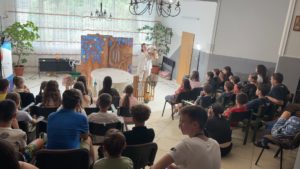

Orysia Krechko, a biology teacher at Turye-Remety Secondary School, conducted an engaging class for high school students on the topic of climate change as a leading cause of rapid biodiversity decline. After explaining the reasons behind climate change and how it poses a threat to all living beings on our planet, the teacher focused on simple, practical steps that students can take to address this issue. “By saving energy, adopting more energy-efficient technologies, walking more, and avoiding unnecessary disposable purchases, we can contribute to the preservation of biodiversity,” explained Orysia Krechko.
When the teacher asked the students if they were willing to compromise on their lifestyles, such as eating or dressing less, they expressed their hesitation. She suggested looking into ways that people might save minerals and natural resources while cutting back on their energy use without noticeably affecting their level of comfort in order to get around this problem. The students found the answers to this question by playing the interactive game called the Energy Efficiency Alphabet. This game taught them how to use energy wisely, save it, and take care of the environment and their own lives.
During the lesson, the students encountered terms like “aerator,” “dimmer,” and “photovoltaic module.” The game helped them quickly grasp the meaning of these terms and understand how these devices can significantly reduce energy consumption. One of the highlights of the class was when the students were challenged to design their own “smart room” that prioritizes energy and cost savings. They used word cards and created diagrams to establish logical connections in their designs. The students greatly enjoyed the lesson, as much of the information presented was new to them.
The students thoroughly enjoyed the lesson, as it presented them with fresh perspectives and new information. They concluded that saving electricity is not an insurmountable task; rather, it requires mindful consideration of their daily habits and choices that directly impact climate change and the decline of plant and animal species.


The event was held within the framework of cooperation between the Interreligious and Civil Environmental Forum of Eastern Europe (IRCEF) headed by Olexander Bokotey) and the German Nature Conservation Union (NABU Bundesverband, NABU International), project coordinators Ivan Tymofeiev (NABU), and Nataliya Kulya (IRCEF).
Informational Service of IRCEF